Fun Facts: Firsts
"Some are last who will be first, and some are first who will be last."
Luke 13:30 (NRSV)
![[Babylonian tablet from Jokha (around 2350 B.C.)]](../images/babyloniantablet.jpg "Babylonian clay tablet From Jokha, ca. 2,350 B.C.")
Babylonian tablet from Jokha, ca. 2,350 B.C.
The ancient Babylonians were the first people to keep written records.
Clay tablets from 3000 B.C. and earlier have been found containing
records of business transactions and judgements.
The first dictionaries known include one made by Chinese scholars in 1109 B.C., and one from Mesopotamia around 600 B.C.
(source)
The only event in the first Olympic Games in Olympia, held in 776 B.C.,
was a footrace, slightly over 200 yards in length, down the centre of the stadium.
The winner, Coroebus of Elis, was awarded an olive branch.
(source)
The first pipe organ was made by Archimedes in 220 B.C.
(source)
The story of Cinderella first appears in a Chinese book written in the 850s.
![[picture of bust of Aristotle]](../images/aristotle2.jpg)
Aristotle.
Aristotle provided the first conclusive argument for a spherical earth
when he noted during a lunar eclipse that the shadow the earth cast on
the moon was circular.
The earliest person on the record as denouncing slavery as an evil was Euripides, who wrote in his play Hecuba, "That thing of evil, by its
nature evil,/ Forcing submission from a man to what/ No man should yield
to."
(source)
The Phoenician navigator Hanno was likely the first to circumnavigate
Africa, around 500 B.C. He observed that, at the southern end of Africa,
the noonday sun shone in the north. This observation sounded
ridiculous to the Greek historian Herodotus, who reported the tale, but
this report shows that Hanno likely either did circumnavigate Africa, or
or at least made a good attempt to do so. He likely wouldn't have
been able to imagine the sun shining in the "wrong" part of the sky if
he hadn't seen it.
(source)
![[picture of bust of Aristarchus of Samos]](../images/aristarchus.jpg)
Aristarchus of Samos.
The first Greek astronomer to suggest the sun was the centre of
the solar system was Aristarchus of Samos, around 290 B.C. No one
took him seriously, and most of his writings were lost. We know of him
today primarily because Archimedes (whose writings do exist)
referred to Aristarchus as holding this apparently nonsensical notion.
(source)
Shi Huang-Ti was the first emperor of a united China and founder of the
Chin
dynasty. Were he a European ruler, he would likely be considered
great. The Chinese, however, have given him a negative
reputation because of his ruthlessness, massive conscription of labour,
wars, harsh laws, and burning of books in 213 B.C.
The saying "When in Rome, do as the Romans do" was first uttered by
St. Ambrose, Bishop of Mediolanum (modern-day Milan). When St. Augustine arrived in Mediolanum in the year 387,
he noticed that the Church in Milan did not fast
on Saturday as did the Church at Rome. He asked Ambrose about this.
Ambrose responded, "When I am at Rome, I fast on a Saturday; when I am at
Milan, I do not. Follow the custom of the Church where you are".
The comment was changed to "When they are in Rome, they do there as they
see done" by Robert Burton in his Anatomy of Melancholy,
and still later took its current form.
(source)
The first person to set foot on Antarctica was an
American sealer, John Davis. He did so on February 7, 1821, but
his accomplishment
was unknown until 1955, when his ship's log was discovered and studied.
(source)
The New Year has been celebrated for over 4,000 years, making it one of the oldest festivals still celebrated today. Celebrating the New Year on January 1st began in the year 46 B.C.
(source)
The first novel ever written is believed to be The Tale of
Genji, written in the first decade of the 11th
century by Murasaki Shibuku, a Japanese noblewoman. It contains 54
chapters.
The first recorded attempt at flight is from 1020, when Oliver
of Malmesbury, an English Benedictine monk, strapped a large pair of
wings to his body and tried to soar into the air from Malmesbury
Abbey. He fell, breaking both his legs.
(source)
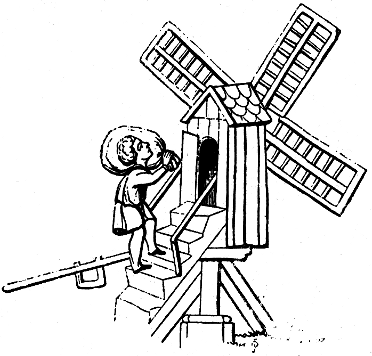
Until the twelfth century, when returning Crusaders brought
knowledge of them, windmills were likely unknown in Europe. They
thereafter became familiar landmarks in Holland, England, France,
and Germany. The first windmill in England was built in 1191, when Dean
Herbert decided to apply wind power to his landlocked farm. He used it
successfully to grind corn until the local abbot had it destroyed.
The first patent for a fax machine was issued to British clockmaker
Alexander Bain in 1843, over 30 years before the telephone.
In 1865, Abbé Caselli introduced the first commercial
facsimile system, between Paris and Lyons. Newspapers began to send
photographs starting in 1902. Modern fax machines were developed by
the Japanese due to difficulties in otherwise transmitting their
written language.
(source)
The first iron wire was drawn at Nuremburg in 1351.
(source)
![[Marie Curie]](../images/curie.jpg)
Marie Curie.
Marie Curie, codiscoverer of radium, was the first person known to
have died of radiation poisoning. Until Curie's death it was not known
that radiation was dangerous.
Ferdinand Magellan was not the first explorer to sail around the world.
During his journey, he and several of his men were killed in the Phillipines.
One of his officers, Juan Sebastián de Elcano, led the
expedition back to Spain.
(source)
Barometers were first made by Torricelli in 1643.
(source)
Sir Walter Scott had the first recorded case of polio, when he was
eighteen months old, in 1773.
In 1662, John Graunt, a London merchant, published the first set
of actuarial tables in his book
Observations on the Bills of Mortality. Graunt provides many interesting statistics regarding causes of deaths in London in 1632.
Seven people are
listed as being murdered, 10 people as having died from cancer, and no specific
mention is made of heart ailments. On the other hand, 13 people
are listed as having died from "planet", 38 from "king's evil", and 98 from
"rising of the lights". Possibly the saddest statistic, however, is that
out of 9,535 deaths that year, infants made up 2,268 of them, over 23%.
(source)
Benjamin Franklin created the first take-out library.
North America's first fatal railway accident on a steam-operated railway was on June
17th, 1831, when the boiler exploded on America's first
passenger locomotive and the first American locomotive in regular
revenue service, the Best Friend of Charleston
(whose first revenue run had been on January 15th of that year), killing
the fireman. The response by the West Point Foundry, which had built the locomotive,
to the boiler failure was by building their next locomotive, the
West Point, with a "barrier car", a car loaded with bales of
cotton to protect passengers.
(source)
![[Best Friend of Charleston]](../images/bestfriend.jpg)
The
Best Friend of Charleston.
The philosopher Immanuel Kant (1724–1804) was the first person to propose that what
we now call galaxies lay outside the Milky Way and were indeed galaxies (or
"island universes", as Kant called them) in their own right.
The first machine gun, the Puckle Gun, built in 1722, was also the most unusual.
It could fire two types of bullets. When targeting lesser enemies
such as other Christians, round bullets were used, but for truly hated enemies
such as Muslims, more destructive square bullets were used.
The world's first automobile insurance policy was issued in 1897, in
Dayton, Ohio, to Gilbert J. Loomis, who purchased a liability insurance
policy from the Travelers Insurance Company for one thousand dollars.
The policy protected Loomis in the event of his car killing or injuring a
person or damaging property.
(source)
Isaac Asimov's first bestseller was his 262nd published
book, Foundation's Edge, in 1982.