Fun Facts: Transportation
"All travelling becomes dull in exact proportion to its rapidity."
—John Rusk
The first recorded attempt at flight is from 1020, when Oliver
of Malmesbury, an English Benedictine monk, strapped a large pair of
wings to his body and tried to soar into the air from Malmesbury
Abbey. He fell, breaking both his legs.
(source)
![[The first iron bridge in the world]](../images/ironbridge.jpg)
The world's first iron bridge.
The first bridge made out of iron had a span of only 100 feet.
It spanned the Severn River at Coalbrookdale and was built in 1777–1778. The bridge still exists today.
(source)
The automobile is over 200 years old. In 1804, Philadelphia ordered a steam-dredge from Oliver Evans, inventor of the high-pressure steam engine and other technology. Evans' shop was a mile and a half from the Schuylkill River, so he mounted one of his engines within the dredge-scow and ran the scow on rollers by steam to the river, making this device the first automobile. When he reached the river Evans substituted a paddle for the rollers and steamed away to Philadelphia, also making this device one of the first steamboats.
(source)
North America's first fatal railway accident on a steam-operated railway was on June
17th, 1831, when the boiler exploded on America's first
passenger locomotive and the first American locomotive in regular
revenue service, the Best Friend of Charleston
(whose first revenue run had been on January 15th of that year), killing
the fireman. The response by the West Point Foundry, which had built the locomotive,
to the boiler failure was by building their next locomotive, the
West Point, with a "barrier car", a car loaded with bales of
cotton to protect passengers.
(source)
![[Best Friend of Charleston]](../images/bestfriend.jpg)
The
Best Friend of Charleston.
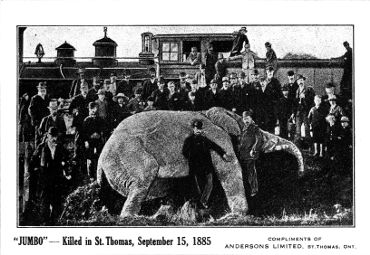
Postcard depicting Jumbo the elephant, killed in St. Thomas, September 15, 1885.
The word "jumbo" comes from the name of Jumbo the circus elephant. Jumbo
was killed on September 15, 1885, after being hit by a
locomotive
in St. Thomas, Ontario, Canada. In 1985,
a life-size (3.35 metres tall) plaster statue of Jumbo was unveiled in
St. Thomas. It was sculpted in New Brunswick and, ironically, was
transported to St. Thomas entirely by truck.
(source)
In June 1872, the steamship Iron Mountain, one of the largest
riverboats on the Mississippi, being over 180 feet long, left the city of
Vicksburg, Mississippi, with fifty-two passengers, a cargo of cotton bales,
and a line of barges carrying cotton and molasses in tow, bound for Pittsburgh.
It was never seen again. Late that morning, the crew of another
steamship spotted the line of barges. The tow line had been cut,
indicating that the crew of Iron Mountain had sensed a problem.
However, there were no traces of the steamship, its crew, or its cargo,
which should have dotted the river for miles had the steamer sank.
(source)
From 1836 to 1895, the Red Flag Act in England required that any
self-propelled vehicle be preceded by a man carrying a red flag by
day and a red lantern by night. This regulation essentially limited the speed
of such vehicles to that of a person and inhibited the development of
self-propelled vehicles such as automobiles.
(source)
In 1898, fourteen years before the Titanic sailed in April 1912
on her maiden voyage from Southampton to New York, Morgan Robertson's novel
Futility was published. It was about an unsinkable and glamourous
Atlantic liner, the largest in the world. Like the Titanic, the
fictional vessel was triple-screw and could make 24-25 knots; at 800
feet it was a little shorter than the Titanic, but at 75,000
tons its displacement was 9,000 tons greater. Like the Titanic's,
its passenger list consisted of many of the top names in high society,
and there were insufficient lifeboats (24 in the novel, 20 on the Titanic). On a cold April night,
the fictional "unsinkable" vessel strikes an iceberg and sinks to the
bottom of the Atlantic. The name of this liner was the Titan.
(source)
![[The iceberg that sunk the Titanic]](../images/titaniciceberg.jpg "The iceberg that sunk the Titanic")
The iceberg that sunk the
Titanic.
The Titanic is the only ocean liner ever sunk by an iceberg.
In the entire state of Ohio in 1895, there were only two cars on the road,
and the drivers of these two cars crashed into each other.
(source)
In 1940, the Tacoma Narrows Bridge (popularly known as "Galloping
Gertie"), which spanned the Puget Sound
south of Seattle, opened. At the time it was the third longest bridge
in the world and narrower than any comparably-sized bridges. Although
the bridge was criticized for being too slender, Leon Moisseiff, the
consulting engineer to the project and an expert on suspension bridges,
assured people that the bridge would be safe. However, only three months after it
opened, the bridge collapsed in a 42 mph wind after going into harmonic
oscillation.
(source)
One of the deadliest train disasters ever was not caused by a collision,
derailment, bridge collapse, or fire.
On the night of March 2nd, 1944,
Italian freight train number 8017 left Salerno, headed south
through the Apennine mountains. Over 650 people had stolen a ride on
the 47-car train, intending to barter cigarettes and other items
with farmers in exchange for milk, eggs, and other rationed foods.
The train passed through Balvano, which lies between two tunnels.
In the first tunnel, the train waited nearly an hour for a downhill
train with locomotive trouble. In the second, the mile-long Galleria
delle Armi, the overloaded train stalled fighting the
steep grade, leaving all but the last three cars trapped inside the
tunnel. The tunnels trapped the carbon monoxide produced by the
locomotives burning their low-grade coal, causing 526
people to die of carbon monoxide poisoning.
(source)
During the building of the Central Pacific part of the American
transcontinental railway over the Sierra Mountains, three locomotives and forty
railway cars were dismantled and hauled over the mountains on sledges and logs.
The most disastrous aeroplane crash in history happened
on the ground, when two 747 jumbo jets collided in Tenerife,
in the Canary Islands, on March 27, 1977. A KLM plane accelerating on
a runway during takeoff ran into a Pan Am plane that was taxiing between
holding areas, waiting its turn to fly, causing 583 people to be killed.
(source)
One of the earliest monorails was the Listowel & Ballybunion
Railway, which spanned nine miles in County Kerry, Ireland. It ran
between 1888 and 1924. Its twin-boilered locomotives and cars
straddled the rail, which was supported on trestles. All loads had
to be balanced. Once, when a piano was shipped it was balanced by
putting a cow on the other side of the car. The cow was shipped
back with two calves on the other half of the car to balance it,
and the calves were returned one on each side of the car.
The world's largest building without internal supports is the Goodyear
Airship hangar, in Akron, Ohio - it has 55 million cubic feet of air.
Clouds form in the top of the structure during sudden temperature
changes, and it rains.
Kenya Railways requires that all trains stop for several minutes
before crossing the Mwatate Dam in the southern part of the country.
The practice was adopted on the advice of local residents after several
mysterious derailments on the dam were blamed on the evil spirits
that inhabit the reservoir. Townsfolk claimed that the spirits were
angered when the trains moved across the dam without first appeasing
them by stopping in tribute.
There is a street in Italy that is only 1.5 feet wide.
The world's shortest street is 6 centimetres long. It is in Scotland.
In America, rail passenger traffic peaked in 1921; volume
has declined more or less steadily since then.
The average American spends 18% of his or her income on
transportation,
and only 13% on
food.
On August 29, 1929 the Graf Zeppelin, a rigid airship (or dirigible), completed a historic flight around the world that included a nonstop leg from Friedrichshafen, Germany to Tokyo, Japan -- a distance of almost 7,000 miles. The airship was 100 feet in diameter and 110 feet high, including the gondola bumpers. During its operating life from 1928 to 1937, the Graf Zeppelin made 590 flights, covering more than a million miles. A total of 13,100 passengers were carried without a single injury.
(source)
On August 25, 1932, Amelia Earhart set three records for female flyers: the first non-stop U.S. crossing, the longest distance record, and a coast-to-coast record time.
(source)
Dr. Samuel Pierpoint Longley flew an unmanned, steam-driven aeroplane on May 6, 1896, a distance of over 3,000 feet. It could have flown a greater distance except that Langley had purposely limited its fuel supply so he could recover it. Hearing of this experiment, the United States Congress voted Langley $50,000 to build a manned flying machine. On two tests in 1903, the last slightly over a week before the Wright Brothers made their first flight, the plane failed to fly, not because of any defects in the plane but due to problems with the launch. Discouraged, ridiculed by the press, and with no more money, Langley gave up. He died three years later, a bitterly disappointed man. However, after his death, Glenn H. Curtiss refurbished his plane and flew it successfully, showing that his plane would have worked.
(source)
Orville and Wilbur Wright made their first successful flight on December 17, 1903. Wilbur and Orville had two older brothers and a younger sister. None of the Wright children were given a middle name.
(source)
The Wright brothers' first flight was shorter than the wingspan of a B-52 bomber.
(source)
After the first powered Wright Flyer of 1903 made history at Kitty Hawk, North Carolina, the Wright brothers disassembled it and shipped it to Dayton, Ohio, where it was stored in a shed behind their bicycle shop for more than a decade. In March 1913, Dayton was hit by a serious flood, and the boxes containing the Flyer were submerged in water and mud for 11 days. In the summer of 1916 Orville repaired and reassembled the airplane for brief exhibition at the Massachusetts Institute of Technology.
(source)
The Wright 1905 Flyer, the first practical airplane, flew for 33 minutes and 17 seconds, covering a distance of 20 miles, on October 4, 1905.
(source)
On Feb. 20, 1962 John Glenn became the first American to orbit the Earth. He made three Earth revolutions in his capsule named "Friendship 7."
(source)
A manned rocket reaches the Moon in less time than it took a stagecoach to travel the length of England.
(source)
The longest train ever was a Norfolk & Western train of 500 coal
cars that travelled 253
kilometres between Iaeger, West Virginia, U.S.A and Portsmouth, Ohio,
on November 15th, 1967. It weighed 42,000 tonnes and was
6.5 kilometres long.