Fun Facts: Animals #3
"The quizzical expression of the monkey at the zoo comes from his wondering whether he is his brother's keeper, or his keeper's brother."
—Evan Esar
For more
interesting facts about animals, see
Animals and
Animals #2.
![[Riftia pachyptila]](../images/riftia_pachyptila.jpg) Riftia pachyptila
Riftia pachyptila.
Image credit: NOAA/Monika Bright.
Biologists divide the animal kingdom into as many as thirty-one different
divisions, called phyla (singular phylum). One animal is so
unique that it has its own phylum. In hydrothermal vents in the ocean
floor lives a reddish worm, Riftia pachyptila,
that creates a long, tough tube to live in. It
ranges up to 25 feet long and ingests food, but has neither a mouth nor
intestines. These worms are apparently nourished by bacteria that live
inside their cells.
Centipedes do not have 100 legs. Different species have between 30 and 346 legs.
Different species of millipedes have between 40 and 800 legs.
Female praying mantises typically do not decapitate or eat their mates.
It is believed that earlier scientists who observed this behaviour either
forgot to feed the mantises or otherwise distracted them, leading to
unusual displays of aggressive behaviour.
(source)
Flatfish (halibut, flounder, turbot, and sole) hatch like any other "normal" fish. As they grow, they turn sideways and one eye moves around so they have two eyes on the side that faces up.
(source)
A rat can go without water longer that a camel can.
In Ancient Egypt, during the season when the Nile flooded,
Egyptians would feed crocodiles by hand.
(source)
The first successful corneal transplant was performed as early as 1835
by a British army surgeon in India whose pet antelope, who had only one
eye, had a badly scarred cornea. He removed a cornea from
a recently killed antelope and transplanted it into his pet's eye. The
operation was a success, and the pet was able to see.
(source)
King Christina of Sweden (all Swedish monarchs were given the title
of King regardless of gender; only the spouse of a monarch would be
called Queen) was so terrified of fleas that she ordered the
construction of a tiny 10 centimetre long cannon so that she could fire
miniature cannonballs at the fleas that infested the royal bedchamber.
It is not known whether she ever managed to hit any.
(source)
In the early 1980's, due to the risk of swine fever, all of the native
Haitian pigs, which were descended from mediaeval European pigs brought to
Haiti during the seventeenth and eighteenth century, were eradicated by
Haitian dictator Jean-Claude Duvalier. French scientists later "re-created"
the extinct Haitian pig by crossing Chinese pigs with Caribbean and
mediaeval Gascon breeds. When the Duvalier regime fell, the French sent
their creation to Haiti.
The animal with the scientific name Puffinus puffinus is a
Manx shearwater, not a puffin.
(source)
The koala is a marsupial, not a bear.
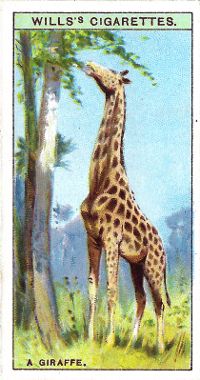
It has always been thought that giraffes have long necks because it
enables them to reach food that other mammals cannot reach. However,
recent research suggests that this may not be the full story. Most of
the vegetation eaten by giraffes is below the height of their neck, where
having a long neck would not be advantageous. However, having a long
neck provides male giraffes with an advantage when mating, which may be
the explanation for why giraffes' necks are so long.
(source)
King Alexandros I of Greece (1917-1920) died from blood poisoning after
being bitten by his pet monkey.
(source)
Ostriches never stick their heads in sand.
(source)
The Falkland Islands have a human population of around 2,000 but a
sheep population of 700,000, making 350 sheep for each person.
(source)
Ninety-nine percent of all forms of life that have existed on Earth
are now extinct.
In 2002, a new species of centipede, Nannarrup hoffmani,
was found in Central Park, in the middle of New York City, New York.
The brain of a Stegosaurus probably weighed about 2½ ounces,
which would have represented 0.004% of its body weight. In comparison,
the brain of a human represents about 1.88% of its body weight.
(source)
During the hundred days of the opening games at the Colosseum in
Rome, in 80 A.D., over 5,000 animals were killed, including
elephants, tigers,
lions, elks, hyenas, hippopotamuses, and giraffes.
(source)
The lions used by the Romans in the Colosseum were Barbary lions,
whose manes covered nearly half of their bodies. While the export
of lions to Rome threatened their population, greater damage was
done after Roman times, when they were killed by Arabs,
encouraged by governments that exempted tribes that killed lions from
taxation. The creature's last stronghold was in the Atlas Mountains,
where the last true Barbary lion was killed in 1922.
The Canary Islands got their name not from canaries but
from the wild dogs that the Romans found when they landed there.
They called the island Insulae Canariae, which means "Island
of the Dogs."
(source)
The ancient Vikings navigated by depending on the instincts of birds.
They took on board several ravens, releasing them one at a time as
they sailed westward. If the raven flew back along the course from
which it had come, the Viking ships continued due west. But when a raven
flew a different way, the ships would change course, following its flight
path in search of new lands.
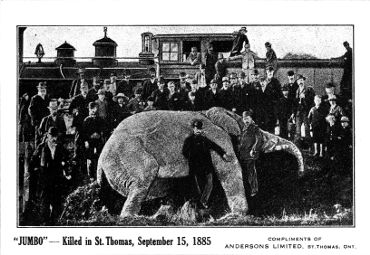
Postcard depicting Jumbo the elephant, killed in St. Thomas, September 15, 1885.
The word "jumbo" comes from the name of Jumbo the circus elephant. Jumbo
was killed on September 15, 1885, after being hit by a
locomotive
in St. Thomas, Ontario, Canada. In 1985,
a life-size (3.35 metres tall) plaster statue of Jumbo was unveiled in
St. Thomas. It was sculpted in New Brunswick and, ironically, was
transported to St. Thomas entirely by truck.
(source)
The kiwi is the only bird with nostrils at the tip of its beak.
While other birds hunt by sight or hearing, the kiwi, which is the
national bird of New Zealand, used its nostrils to smell food at night.
Although the kiwi is about the same size as a chicken, it lays
eggs ten times larger than a hen's.


![[an Egyptian crocodile]](../images/crocodile.jpg)