Fun Facts: English Words #2
"Clearly spoken, Mr. Fogg; you explain English by Greek."
—Benjamin Franklin
A group of magpies is called a tiding, one of ravens an unkindness,
one of turtledoves a pitying, one of starlings a murmuration, one of
swans a lamentation, one of ponies a string, one of rattlesnakes a
rhumba, one of crows a murder, one of cobras a quiver, one of foxes a
skulk, one of emus a mob, one of elks a gang, one of cats a clowder,
one of flamingoes a pat,
and one of bears a sleuth.
Groups of geese are named in a peculiar manner; when they are on the
ground they are called a "gaggle", but in the air they are called a
"skein".
(source)
Viking ships were steered by rudders on the right side, which the
Vikings called styrbord, Old Norse for "steer side", from which the
English word "starboard" comes. The Vikings docked their
ships on the left side, which they called the ladebord, the
"loading side". This eventually became the English "larboard", which
sounded so much like "starboard" that it caused problems. Eventually,
the British Admiralty ordered that the left side be known as the "port" side.
(source)
The word "daisy" comes from the Old English "daeges eage", meaning
"day's eye", as it reminded people of the sun.
The word "nice" originally mention "foolish". In the 15th century,
the word came to mean "coy", and in the 16th century, "fastidious."
By the 18th century the word had assumed its modern meaning.
(source)
Many European advances during the Middle Ages were made possible by
the Moorish occupation of Spain. The most important was the use of
Arabic numerals. The Moors also brought other discoveries to Europe,
which is reflected by the fact that words such as "algebra", "lute",
and "magazine" are of Arabic origin. The Moors also
introduced the game of chess into Europe.
The word "spa" comes from the Belgian town of Spa, in the Ardennes, whose
mineral springs and baths were popular among the wealthy starting in the
18th century.
(source)
The words canteloupe, cashmere, champagne, cherry, coach, cologne,
copper, and currants are derived from place names. There are many other
words derived from place names that
start with the other 25 letters of the alphabet as well.
(source)
The word "holiday" comes from "holy day". During the Middle Ages, there were over 50 "holy days" and festival days, exclusive of Sundays, every year. This meant that peasants would only work for 260 days out of the year.
The "sh" sound, as in the word "ship", can be represented by eight
different combinations of letters in English, as in the words
ship,
suspicious,
ocean,
anxious,
sure,
conscience,
notion,
and issue.
Until around the end of the nineteenth century, the word abacot
was defined in many dictionaries as a cap of state formerly used by English
kings, wrought in the figure of two crowns. However, in 1882 Sir James Murray,
editor of the Oxford English Dictionary, discovered that neither
the word abacot or the object that it refers to are real. In a 1548
history of the kings of England by Edward Hall, the printer mistook the words
a bicocket, which is a type of helmet, for abococket, which
eventually made its way into dictionaries as abacot.
(source)
Shakespeare used around 29,000 different words in his plays.
About 6,000 words only appear once.
About 10,000 words are not found
in any surviving English
literature prior to Shakespeare.
(source)
English is the only language that capitalises the first person
singular, "I".
(source)
Spaghetti means "little strings" in Italian.
The word "dunce", meaning a dull-witted or ignorant person, comes
from the name of John Duns Scotus (1265-1308), one of the greatest
minds of his time. Scotus, born in Scotland, wrote treatises on
grammar, logic, metaphysics, and theology. He was educated at
Cambridge and Oxford and pursued his master's degree in theology at
the University of Paris where, in 1303, he became embroiled in one
of the most heated disputes of the day. France's King Philip IV had
moved to tax the Church in order to finance his war with England; in
response, Pope Boniface VIII threatened to excommunicate him. For
supporting the pope, Duns Scotus was banished from France. He later
assumed a university professorship in Cologne.
The term "dunce" was coined two centuries later by people who disagreed
with Scotus' teachings and his defence of the papacy. To them,
any of his followers (a "Duns man" or "Dunce") was dull-witted, "incapable of scholarship and stupid".
(source)
The word "kindergarten" comes from the German for "children's garden".
Friedrich Froebel, who coined the term, originally was planning
to use the term "Kleinkinderbeschäftigungsanstalt" instead.
(source)
The words "best" and "worst" are both synonyms and antonyms.
The two words are best known as opposite adjectives, but as verbs, both
words mean "to beat".
The largest number in the English language with a word naming it is a googolplex. This number is equal to 10 to the power of a googol, or 10 to the power of 10100. This number would be written as 1 followed by 10100 zeroes (except that, as there are far fewer particles in the universe than there are zeroes in a googolplex, the number could never be written out in full). The names "googol" and "googolplex" were both suggested in the 1930s by Milton Sirotta, the nine-year-old nephew of mathematician Dr. Edward Kasner.
(source)
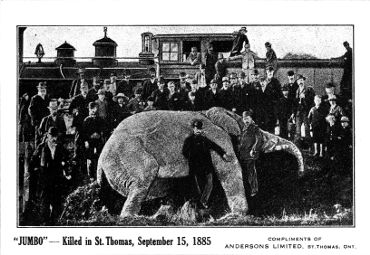
Postcard depicting Jumbo the elephant, killed in St. Thomas, September 15, 1885.
The word "jumbo" comes from the name of Jumbo the circus elephant. Jumbo
was killed on September 15, 1885, after being hit by a
locomotive
in St. Thomas, Ontario, Canada. In 1985,
a life-size (3.35 metres tall) plaster statue of Jumbo was unveiled in
St. Thomas. It was sculpted in New Brunswick and, ironically, was
transported to St. Thomas entirely by truck.
(source)
The word "posh" dates from the 19th century, as a slang term for
a low-denomination coin. For some unknown reason, later on in the
century, it came to connote a dandy, and from there evolved to mean
stylish. The modern sense of the word was first used in Punch
magazine on September 25, 1918. There is an urban legend that the word
"posh" is an acronym for "port out, starboard home" on tickets to India
that would entitle the bearers to avoid the hot sun going both out and
back, but there is no contemporary evidence to support this derivation.
(source)
One of the possible etymologies for the word "lackey" is from
the Arabic al-qadi, meaning "the judge".
The word "dandelion" comes from the supposed resemblance of the
leaf spikes of this plant to a lion's tooth, or, in French, dent de lion.
(source)
The carat was derived from the weight of a seed of the carob tree.
The weight of each bean is quite consistent, with about 142 beans to
the ounce.
(source)
In the thirteenth century, the word "girl" meant any young
person, female or male.
(source)
The word "quilt" originally referred to the bedding underneath a
sleeper, not the covering on top of a sleeper. The word comes from
the Latin culcita, "mattress".
(source)
Until recently, the word "sophisticated" meant "false".
Until 1898, an average score for a hole in golf was called a bogey (Scottish for ghost). A modern ball was introduced in 1898 that took about one fewer strokes to reach the hole, so the new standard
was called par (short for parity).
(source)