Fun Facts: Technology and Inventions
"And there's a dreadful law here
... if anyone asks for machinery, they have to have it and
keep on using it."
—Edith Nesbit, The Magic City
Primitive batteries capable of producing ½ volt
of electricity were made in Mesopotamia between around 200 B.C. and 200 A.D.
They were likely used for electroplating silver onto copper.
(source)
Among the important devices in naval technology developed by the
Chinese are: the stern-post rudder, which appears on a pottery model
of a boat dating from the first century A.D.; watertight compartments;
and the paddle wheel, descriptions of which date from the fifth
century A.D.
(source)
The umbrella was invented by the Chinese in the second century B.C.
Glass mirrors were known in the Roman Empire, but the art of making them was lost and not recovered until 1300 in Venice.
(source)
Billiards were invented in France in 1471.
(source)
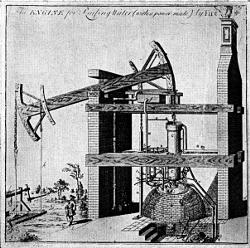
An explanatory drawing of the Newcomen pumping engine produced in 1717.
James Watt did not invent the steam engine. In 1763, he hit upon
an innovation to the Newcomen steam engine.
The Newcomen engine was incredibly inefficient, wasting enormous
amounts of steam because vapourization and condensation took place
in the same chamber. Watt introduced a separate condensing vessel
which greatly increased the work efficiency of the machine.
(source)
Looking through his telescope in 1609, Galileo saw that there were spots on the Sun, imperfections on the Moon, and that the Milky Way was composed of millions of faint stars. His most stunning (and controversial!) discovery was of satellites orbiting Jupiter, dashing the concept that the Earth was the center of the Universe.
(source)
Thomas Jefferson invented the swivel chair, the pedometer, a letter-copying
press, a tilting table, a more effective plough,
and several other items.
He never patented any of his inventions, wanting people to have
free use of them.
The first patent for a fax machine was issued to British clockmaker
Alexander Bain in 1843, over 30 years before the telephone.
In 1865, Abbé Caselli introduced the first commercial
facsimile system, between Paris and Lyons. Newspapers began to send
photographs starting in 1902. Modern fax machines were developed by
the Japanese due to difficulties in otherwise transmitting their
written language.
(source)
In June 1935, Major Radiovision of London started to sell videodiscs.
Each side of a disc offered six minutes of pictures and sound, which
could be viewed using a device linked to a primitive television set.
The discs were never commercially successful.
(source)
It is possible that
the science-fiction writer Arthur C. Clarke might have lost out on
millions of dollars in royalties when he wrote an article about
radio communication via satellite before first taking out a U.S. patent.
(source)
The advent of the photo-finish camera in horse racing took the guesswork
out of judging, and showed that human judges, while generally accurate, were
not so on close calls. In 1935, before cameras, judges called only
20 dead heats, but in 1938, after cameras had been introduced at most tracks,
cameras showed 264 dead heats. It would appear that, before cameras, judges
had miscalled thousands of tied races due to a combination of human error and
the desire to have a decision.
The last person on the moon was Eugene Cernan. He and fellow explorer
Harrison Schmidt left the moon at 5:40 A.M. GMT, December 13th,
1972. No humans have visited the moon since then.
On July 22nd, 1962, the Mariner I space probe was launched from Cape
Canaveral, Florida, en route to Venus. Four minutes after lift-off, it
crashed into the Atlantic Ocean, resulting in an
$18.5 million loss for the U.S. space program. An investigation found
the cause of the crash to be the omission of a single minus sign
from the instructions entered into the rocket's computer.
(source)
The engineering division of British Rail applied for and received a
patent for a flying saucer in 1972.
It would be capable of transporting 22 passengers.
However, the nuclear fusion technology used to power it does not exist,
and it appears that by 1976 they lost faith in the practicability of the
saucer, and allowed the patent to lapse.
(source)
On October 4, 1957, the Soviet Union successfully launched Sputnik I,
Earth's first artificial satellite. It was quite small, being about the
size of a basketball and weighing 183 pounds. It took about 98 minutes
to orbit the Earth on its elliptical orbit.
(source)
In 1950, the Illinois Central Railroad
operated 1,166 steam locomotives and 89 diesel locomotives. It had
replaced all its steam locomotives with diesel locomotives by 1960.
Despite the fact that it would take two or three diesels to replace
a heavy steam locomotive, the Illinois Central was operating its
railway in 1960 with only 600 diesels. This was possible because
diesels could be utilized more heavily.
A robot has already killed a human. In the summer of 1981, a
Japanese industrial robot malfunctioned. Its repairman neglected to
open the chain fence around the robot that would have shut off the
robot's power, and then accidentally touched the switch that turned
the robot on. The robot then performed the actions that it was
designed to do, and with the human in the way the robot caught the
employee, pinning him against a machine processing automobile gears,
killing him.
In 1967, Keuffel & Esser, a maker of slide rules, commissioned
a study of the future. The report predicted that, by the year 2067,
Americans would live in domed cities and watch three-dimensional television.
Unfortunately for the company, the report failed to predict that slide rules would
be obsolete in under ten years, to be replaced by the pocket calculator.
By 1976, Keuffel & Esser, who were now selling Texas Instruments calculators
much faster than slide rules, which made up only 5% of their sales,
mothballed its slide rule manufacturing equipment and sent it to the
Smithsonian Institution.
(source)
The Bluetooth technology is named after a tenth-century king of Denmark and Norway,
Harald Bluetooth. Harald was known for uniting various warring tribes in
Denmark and Norway, as the technology is intended to unite various other
technologies.
On March 16, 1926, Dr. Robert H. Goddard successfully launched the first liquid fueled rocket. The launch took place at Auburn, Massachusetts, and is regarded by flight historians to be as significant as the Wright Brothers flight at Kitty Hawk.
(source)
Data from satellite instruments are used by fishermen to find areas where fish are most likely to be found. Fish find food in zones where cold and warm water mix.
(source)
A geostationary satellite travels at an altitude of approximately 36,000 kilometres (22,000 miles) above the Earth and at a speed of about 11,000 km/h (7,000 mph).
(source)
In the mid-1960s, NASA's Jet Propulsion Laboratory developed digital image processing to allow computer enhancement of Moon pictures. Similar technology is now used by doctors and hospitals on images of organs in the human body.
(source)
The main engine of the Space Shuttle weighs one seventh as much as a locomotive but delivers as much horsepower as 39 locomotives.
(source)
The Space Shuttle travels about 17,600 miles per hour when orbiting the Earth.
(source)
The Hubble Space Telescope was launched by the U.S. on April 24, 1990 and is named after Astronomer Edwin P. Hubble. It is a Low Earth Orbiting (LEO) satellite, located about 375 miles (600 km) above the surface of the Earth. Hubble completes an orbit around the Earth every 97 minutes.
(source)
Every day, the Hubble Space Telescope archives 3 to 5 gigabytes of data and delivers between 10 and 15 gigabytes to astronomers.
(source)
The first typewritten manuscript was Mark Twain's manuscript of Tom Sawyer, in 1875.
(source)
David Hahn built a small nuclear reactor in a backyard shed in suburban
Detroit in 1994. He had to shut it down after the authorities noticed.
In 2007 he was caught stealing smoke detectors, possibly for the small amounts
of radioactive substances contained within, and sentenced to 90 days in gaol.
(source)
Around the year 1900, fear of premature burial was very strong. In the early 1900s, Franz Hartmann claimed to have collected around 700 cases of either premature burial or "close calls". In 1896 the "Society for the Prevention of Premature Burial" was founded. In 1897, in Germany, a patent was granted for a device that sent up a warning flag and turned on a light if movement was detected inside the coffin. Modern technology eventually put an end to the premature burial fear.
(source)